From Stone to Space, From Object to Idea
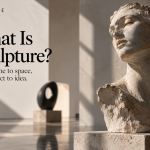
You can walk around a sculpture.
You can approach it, step away from it and see it from different angles.
As the light changes, its surface changes. When its surroundings change, our relationship with it may change as well.
While painting often creates its own world on a surface, sculpture enters the physical world we inhabit.
Sculpture is not simply an object. It is a relationship between space, material, the body and the viewer.
The history of sculpture is therefore not only the history of stone, marble or bronze.
It is also the history of our desire to give physical form to ideas.
Why did humans make sculpture?
Sculpture is one of humanity’s oldest forms of artistic expression.
For thousands of years, people have used stone, bone, clay, wood and metal to create three-dimensional representations of humans, animals, gods and symbolic figures.
These objects were not always made simply for aesthetic purposes.
They were connected to religion, death, power, memory and collective identity.
In ancient societies, sculpture often became a way of preserving the presence of rulers, gods and important individuals.
A person could die.
Their image in stone could remain.
From very early in human history, sculpture became a powerful connection between the body and memory.
The body within the stone
Stone is one of the most enduring materials in the history of sculpture.
Marble, in particular, has played an extraordinary role in the representation of the human body in Western art.
From a hard block of stone, a sculptor can create the appearance of soft flesh.
Skin, hair, fabric and movement can emerge from the same material as completely different surfaces.
There is an intriguing paradox here.
Stone is heavy.
The body moves.
Stone is cold.
The body is alive.
One of the great achievements of sculptural traditions has been the ability to make these contradictions almost disappear.
The artist gives the impression of life to an inanimate material.
Making sculpture: Removing or adding?
One of the fundamental methods of sculpture is subtraction.
When stone or wood is carved, the artist removes material in order to reveal a form.
But sculpture is not always created this way.
With materials such as clay, an artist can construct a form by adding material.
Bronze sculpture may involve modelling an original form before creating moulds and casting the final work.
Contemporary sculpture can involve welding, assembling, attaching, stacking or combining existing objects.
The history of sculpture is therefore also a history of different ways of making:
carving, modelling, casting, constructing and assembling.
Why is sculpture three-dimensional?
We usually encounter a painting from the front.
Sculpture can resist a single viewpoint.
What you see from the front may look completely different from what you discover behind it.
Walking around a sculpture means discovering the artwork over time.
As the viewer moves, the sculpture seems to change.
For this reason, one of sculpture’s essential dimensions is not simply volume.
It is also time.
To experience a sculpture fully, we may need to move.
The artwork remains still.
The viewer moves.
The experience emerges from the encounter between the two.
Empty space is also part of sculpture
It is easy to think of sculpture only in terms of solid material.
But the empty space around and within a sculpture can also become part of its composition.
The gap between an arm and a body.
The sky visible through pieces of metal.
An opening cut through a form.
All of these spaces contribute to the visual structure of the sculpture.
As modern sculpture developed, artists began to use empty space increasingly actively.
Sculpture was no longer simply an object occupying space.
It could become something that shaped space itself.
Rodin and the unfinished surface
Auguste Rodin represents an important turning point in the development of modern sculpture.
In Rodin’s work, bodies are not always perfectly finished, idealised or smooth.
Traces of modelling and irregular surfaces may remain visible.
Some figures appear almost as though they have not fully emerged from the material.
This approach strengthened an important idea:
A sculpture did not have to appear perfectly finished.
Evidence of the artist’s process could remain part of the work.
This idea opened enormous possibilities for modern and contemporary sculpture.
Modernism: The body begins to change
By the twentieth century, sculpture was undergoing a transformation similar to painting.
The human body no longer needed to be represented with anatomical accuracy.
A figure could become elongated.
Fragmented.
Reduced to geometric forms.
Or disappear entirely.
Artists increasingly approached sculpture not simply as a way to represent people or objects, but as an independent language through which they could explore form, volume, balance and space.
Abstraction transformed sculpture.
A sculpture no longer had to be a sculpture of something.
It could exist as a form in its own right.
New materials
Modern and contemporary art radically expanded the material vocabulary of sculpture.
Marble and bronze remained.
But they were joined by:
steel,
aluminium,
glass,
plastic,
concrete,
textiles,
rubber,
earth,
wood,
light,
and objects taken from everyday life.
The choice of material was no longer simply a technical decision.
The material itself could carry meaning.
Rusting metal might suggest the passage of time.
Fragile glass might evoke vulnerability.
Recycled objects could address consumption and waste.
This makes one question particularly important in contemporary sculpture:
Why has the artist chosen this specific material?
Can an ordinary object become sculpture?
This became one of the most radical questions of twentieth-century art.
What happens when an artist does not make an object by hand, but instead selects an existing everyday object and places it within an artistic context?
This idea fundamentally changed the boundaries of sculpture.
The value of an artwork could no longer be understood solely through manual skill.
Selection, context and concept could also become part of artistic creation.
The question was no longer only:
“How did the artist make this?”
Another question became equally important:
“Why has the artist presented this as art?”
Sculpture and space
Where a sculpture is placed can fundamentally change its meaning.
The same sculpture can create completely different experiences inside a museum and in the centre of a city.
Public sculpture interacts with architecture, streets, weather and everyday life.
People walk past it.
Children may play around it.
Snow may settle on it.
Rain may change its surface.
Over time, it can become part of the memory of a place.
Public sculpture is therefore not always simply an art object.
Sometimes it becomes part of a place’s identity.
Where does sculpture end and installation begin?
Contemporary art offers no definitive answer.
Instead of creating a single object, an artist may transform an entire space.
Walls, floors, light, sound and multiple objects can all become parts of the work.
At this point, the boundary between sculpture and installation begins to blur.
A traditional sculpture can often be moved from one location to another.
In installation art, the surrounding space may become inseparable from the artwork.
Contemporary practice continually challenges even this distinction.
Sculpture is no longer necessarily an object placed within a space.
Sometimes it transforms the space itself.
Does the body still matter?
Absolutely.
After thousands of years of sculptural history, the human body remains one of art’s central subjects.
But contemporary artists do not necessarily use the body simply as an ideal of anatomical beauty.
The body can become a way of thinking about:
identity,
ageing,
power,
vulnerability,
gender,
migration,
memory,
and social relationships.
A body may be incomplete, fragmented or transformed deliberately.
Sculpture does not simply represent the body.
It can make us think about what it means to inhabit one.
How should we look at sculpture?
Walk around it.
If possible, do not experience it from only one angle.
Move closer.
Then step back.
Look at the surface.
Is it smooth?
Rough?
Reflective?
Has the artist hidden the natural character of the material, or deliberately allowed it to remain visible?
Then consider its relationship with its surroundings.
How does the sculpture change the space around it?
And ask yourself:
Would this work mean the same thing if it were somewhere else?
One way of understanding sculpture is to stop thinking of it simply as an object and begin experiencing it as an encounter within space.
Why does seeing the original matter?
Sculpture is one of the art forms in which the limitations of digital images become particularly obvious.
A photograph shows us only a selected viewpoint.
We may not understand the scale.
We cannot fully experience the weight of the material.
We may not see how the surface responds to changing light.
A sculpture ten centimetres high and another four metres high can appear almost the same size on a phone screen.
A digital image therefore cannot replace the physical experience.
But it can do something important:
It can make discovery possible.
We can encounter a sculptor we have never known before, explore works from different periods and begin to understand how the artist’s visual language has developed.
Sculpture in the 21st century
Today, the boundaries of sculpture are wider than ever.
An artist can still carve marble.
Cast bronze.
Shape wood.
But sculpture can also involve light, plastic, textiles, digital technologies or recycled materials.
A sculpture can be small enough to hold.
It can occupy an entire public square.
It can hang from a ceiling.
Exist within a landscape.
Merge with architecture.
It may even be temporary and eventually disappear completely.
This diversity does not mean sculpture has lost its identity.
Instead, it demonstrates that one of its oldest questions remains alive:
How can an idea take physical form in the world?
THEARTE PERSPECTIVE
At Thearte, presenting sculpture digitally carries a particular responsibility.
Reducing a three-dimensional artwork to a single photograph can make important aspects of the work invisible.
Showing sculpture from different angles, clearly stating its dimensions and materials, and — whenever possible — presenting its scale within a physical environment can help the viewer understand the work more fully.
A collector should not simply see an attractive photograph.
They should be able to move closer to understanding the artwork itself.
At the same time, a single sculpture is rarely enough to explain an artist’s practice.
When works from different periods are brought together, we begin to see how materials, forms and ideas develop over time.
An artist’s gallery therefore becomes more than a catalogue of objects.
It becomes a record of artistic and intellectual development.
At Thearte, we believe independent artists should have the space to build and present this continuity themselves.
Because understanding an artist does not mean seeing only their latest work.
It means seeing the language they have built over time.
DISCOVER ART
Explore original paintings, sculptures and works across different disciplines by independent artists from around the world on Thearte.
For artists:
Create your personal gallery, present your work with accurate information and multiple views, and introduce your artistic practice to an international audience.
For collectors and art lovers:
Discover new artists, explore the wider development of their work and encounter original art from different cultures and perspectives.
THEARTE
Independent Art. Independent Artists.


Explore the development of painting from representation and Impressionism to Cubism, abstraction, contemporary figuration and painting...

When we stand in front of a work of art, our first reaction is often immediate....